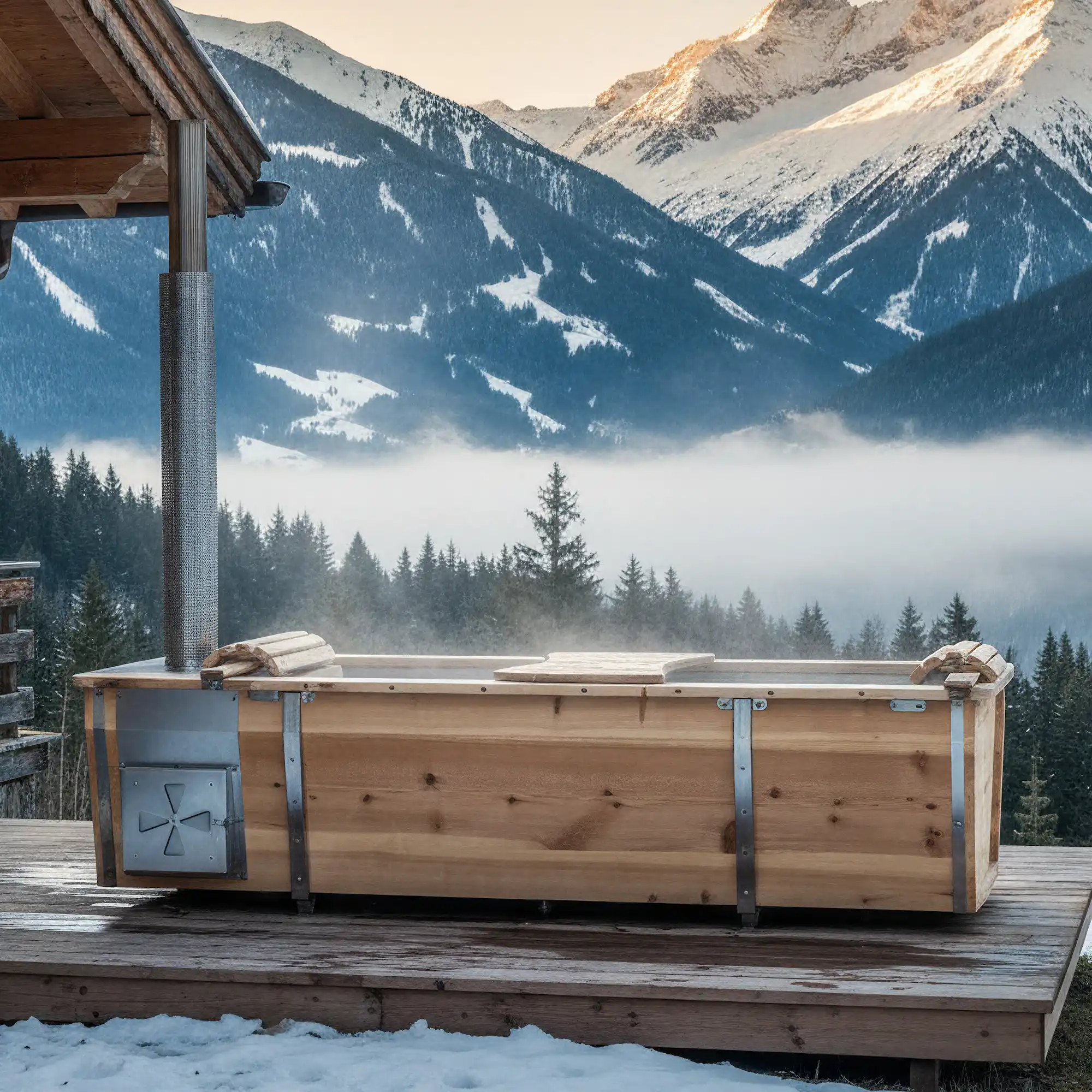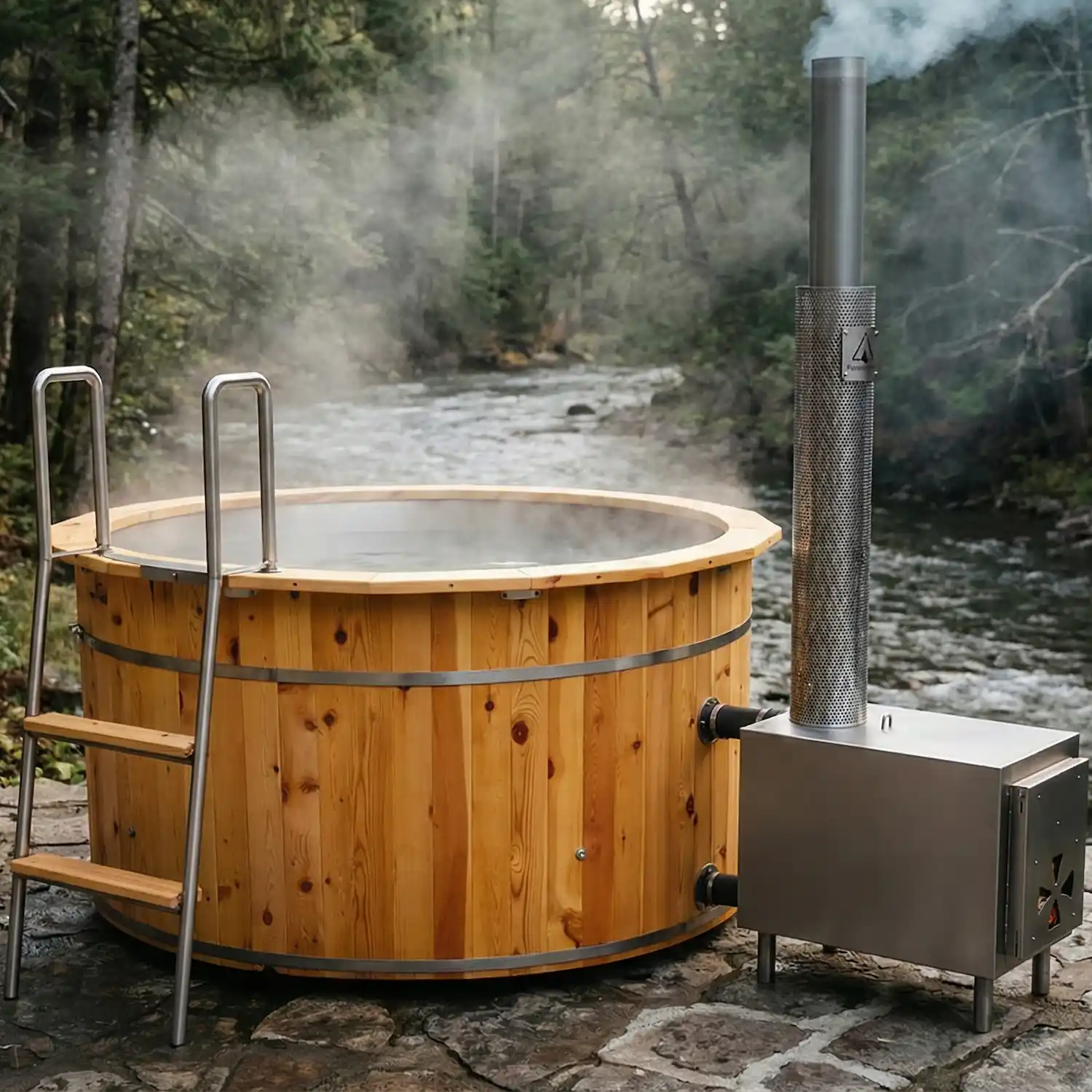
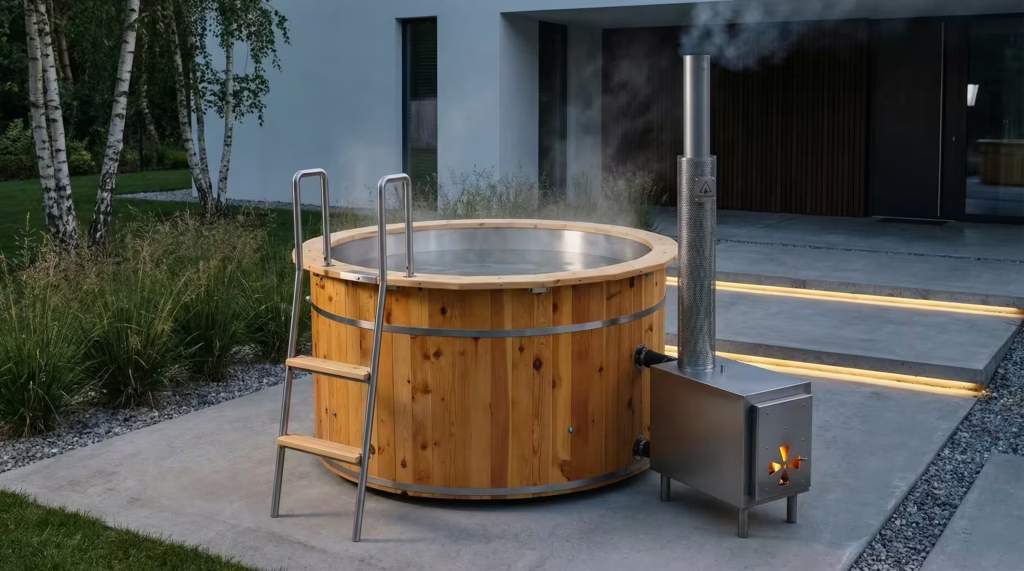
A wooden hot tub is the picture that appears in most people’s heads the moment they think about hot bathing outdoors: warm pine, steaming water and a stove crackling quietly beside it.
Wood is a wonderful material, and that is exactly why it is worth taking a closer look at what it actually does on a tub like this. In this article we look at why wood has been used for the job for centuries, how a classic bathing tub is built, and why on the Feuerwasser Wood-fired Hot Tub we put the wood on the outside and the stainless steel on the inside.
Why a wooden hot tub is so popular
Wood does something to a bathing tub that no other material manages quite as well: it takes the hardness out of the construction. A barrel with a pine cladding never looks like a technical appliance in a garden, it looks like a piece of furniture that has been standing there for a while already. The material ages visibly, it turns greyer over the years and develops texture, and most people find exactly that beautiful.
On top of that comes a very practical point you only notice once you use it: at the rim, wood never feels unpleasantly cold or unpleasantly hot. When you rest your wet arms on the edge in winter, you feel that difference immediately. And the smell that warm pine gives off on a summer evening is simply part of the whole thing for us.
How a classic wooden bathing tub is built
A classic bathing tub is made of wood inside and out. The individual staves are held together by steel hoops and seal themselves by swelling as soon as they get wet. It is one of the most elegant constructions the craft has ever produced: it needs no sealant of any kind and has worked for centuries purely through the properties of the material.
Wood is a living material in this respect. It works with the moisture, it swells and shrinks again, and a tub built this way likes being used regularly. Anyone who goes along with that rhythm gets a genuine piece of craftsmanship standing in the garden in return.
We wanted to build a barrel that is ready to use straight away even after two months of standing untouched – in the depths of winter just as much as in the middle of the holiday season. So we separated the two jobs, staying watertight and looking beautiful, from one another.
On our wood-fired hot tub, the wood sits on the outside

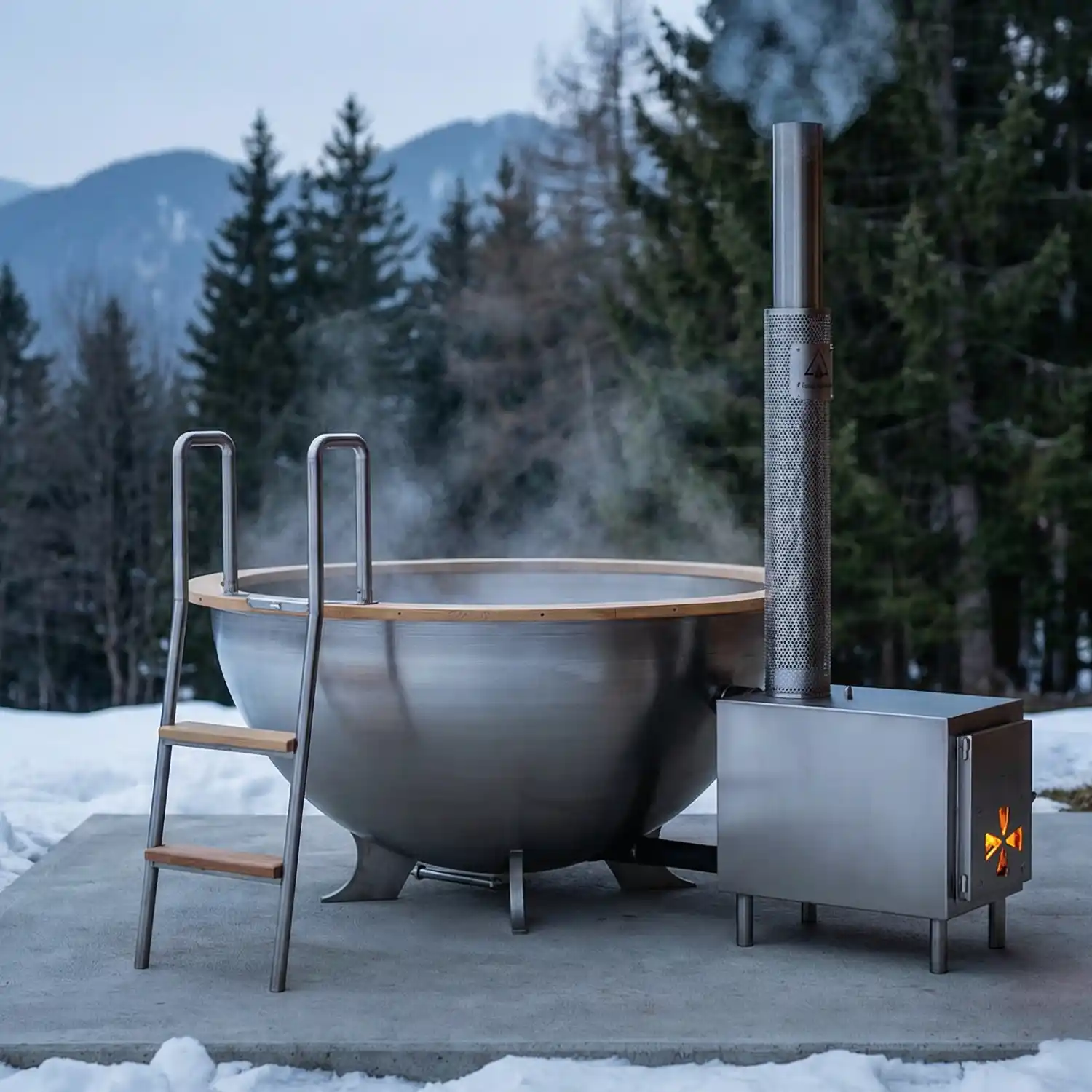
On the Feuerwasser Wood-fired Hot Tub, each material takes on the job it is strongest at: inside sits a seamless tub made of solid V4A stainless steel, outside there is a cladding of solid pine. From the outside you get exactly the wooden hot tub you picture – the look, the warmth at the rim, the texture under your hands.
The wood simply no longer has to be watertight, which leaves it completely free to just be beautiful. You can drain the barrel and leave it empty for weeks, and next time you simply fill it up again. With around 1,400 litres of water and room for up to six people, it is less an appliance than a meeting point.
External or internal stove
The same line of thinking applies to the stove. Some wooden hot tubs have an internal stove that stands directly in the basin, surrounded by the bathing water on all sides. On paper that saves space, but in everyday use the design brings several drawbacks with it: lighting the fire is considerably more awkward, because you have to lean over the rim and the stove barely draws while it is still cold. Clearing out the ashes becomes a wet and sooty job. And since the stove stands in the middle of the basin, it not only takes away seating space, it also means you are sitting right next to glowing hot metal the whole time you bathe.
We built internal stoves ourselves years ago and then took them out of our range again quite deliberately – simply because many of our customers never managed to get a decent fire going with them. With an external stove the fire burns where it belongs: outside the barrel, easy to reach at any moment, with a proper draught and with no hot surfaces anywhere in the bathing area.
Pine in practice: the choice is yours
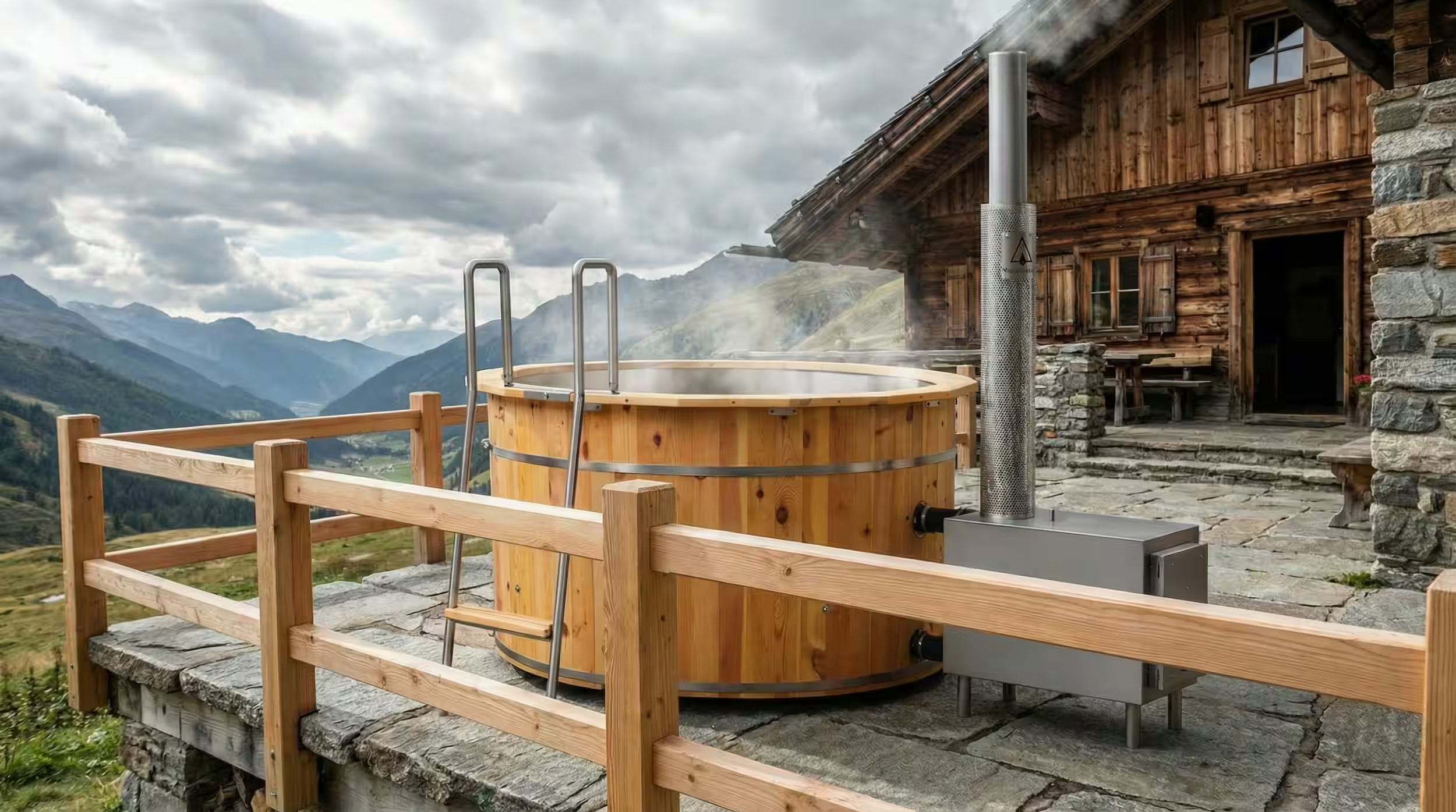
Because the wood serves as cladding with us, you have a completely free hand when it comes to looking after it. There are two ways to go, and both of them are right:
- You let the wood do its thing. Outdoors, pine weathers over the years into a calm silver-grey, the same way it does on an alpine hut. Plenty of our customers like the barrel best in exactly that state.
- Or you treat the wood with a glaze every one to two years and keep the warm, red-brown tone of fresh pine.
Both are purely a matter of taste. Whether the wood happens to be soaking wet or bone dry makes no difference at all to how the barrel works – so all you are deciding is how it should look.
Hygiene: why the inside makes the difference
The inner tub is made of non-porous V4A stainless steel: smooth, completely sealed and without a single joint. Bacteria and biofilm have nothing to cling to on a surface like that, which is why you need no chlorine, no bromine and no test strips.
The routine after bathing is correspondingly short: drain the water through the floor outlet, wipe down the walls, done. There is no filter to change and no pipework to flush. Next time you simply fill in fresh water again – and because heating with wood costs nothing beyond a few logs, that is also the most straightforward way to do it.
The facts about the Feuerwasser Wood-fired Hot Tub
- Material: V4A stainless steel inside, solid pine outside
- Capacity: for up to 6 people
- Volume: 1,800 litres (fill quantity approx. 1,400 litres)
- Dimensions: outer diameter 180 cm, height 105 cm
- Stove: external V4A stove, approx. 35 kW
- Heating time: from 10 °C to 38 °C in 150 to 210 minutes
- Warranty: 5 years on the stainless steel body
- Origin: handcrafted in Austria, free delivery (mainland EU & Switzerland)
Conclusion: wood where wood is at its best
On a bathing tub, wood is irreplaceable. It shapes the look, it feels right under your hands, and it makes sure the barrel does not sit in the garden like a piece of equipment but like something that has always belonged there.
With a seamless inner tub in V4A stainless steel and a cladding of solid pine you get both at once: the warmth and the presence of wood, and an inside that simply stays watertight for decades.
Crafted for the Elements.
Want to know what your wood-fired hot tub would cost? Request your individual quote now.

About the author
Karlheinz Levounigg worked at Feuerwasser back in 2023 and knows the hot tub, bathing barrel and outdoor shower from the inside. Today, as co-founder of SWIFTGREEN OG, he looks after the Feuerwasser website and online marketing.
His articles focus on what matters in practice: the right location, heating up, care and the honest question of which product suits whom. Crafted for the Elements.