Deciding on a hot tub for the garden is usually the quick part. The more interesting questions come afterwards: where exactly do you put it? What can the ground underneath take? Do you need a power supply, a permit, a conversation with the neighbours?
In this article we go through, one at a time, what you should genuinely clarify before you buy. Without sugar-coating anything, but also without inventing problems that turn out not to be problems at all – because most gardens are better suited to this than their owners assume.
How much space a hot tub in the garden really needs
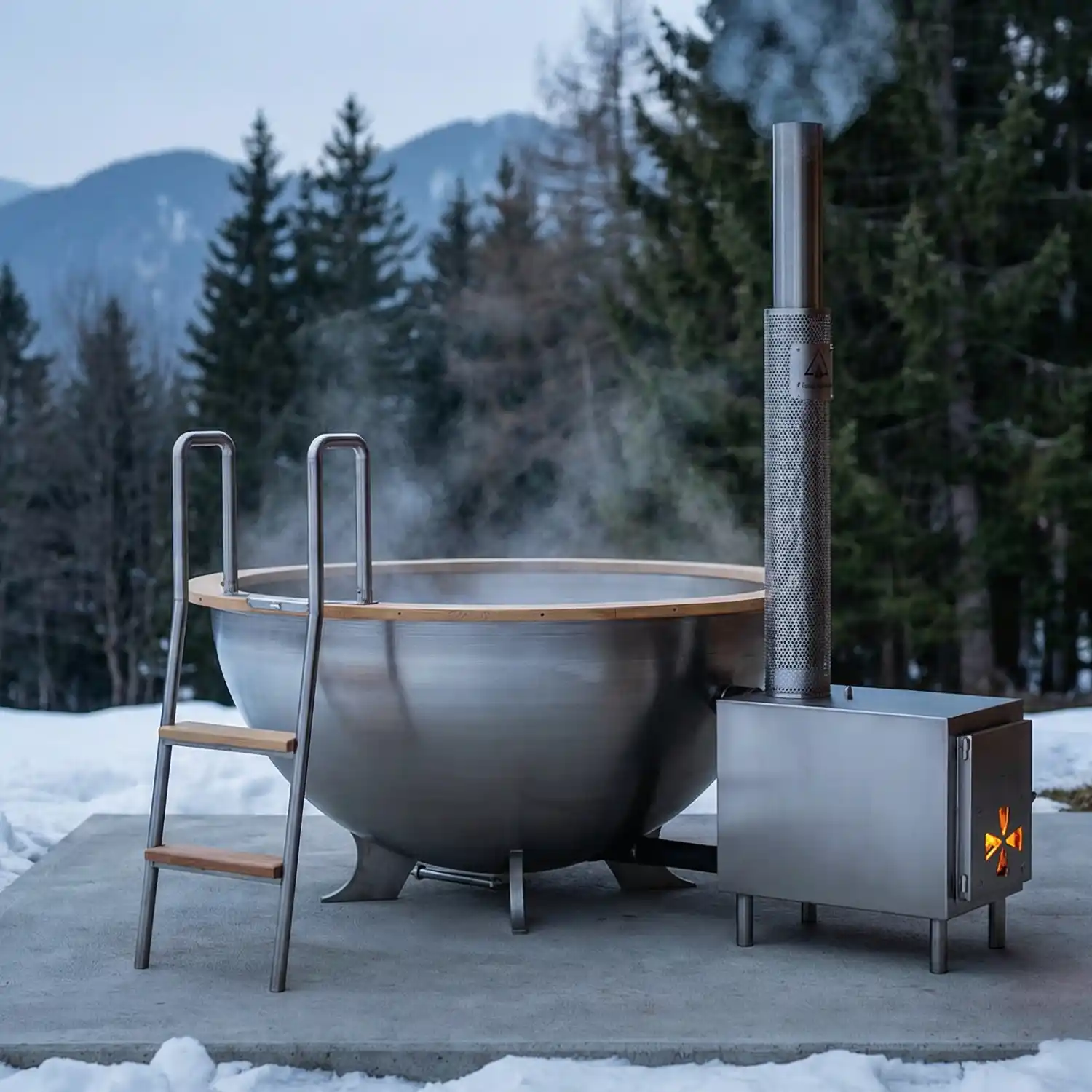
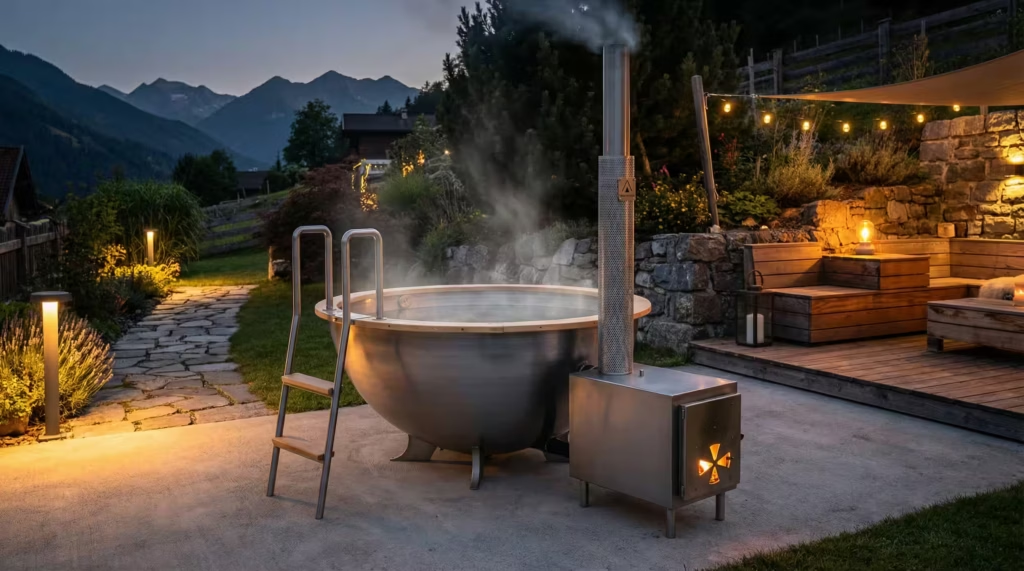
The Feuerwasser Stainless Steel Hot Tub has an outer diameter of 180 cm. On top of that comes the stove, which does not sit inside the basin but stands beside it, connected by two hoses.
For your planning it is therefore best to reckon with an area of roughly 3.10 × 2.60 metres. That gives tub and stove room side by side, and still lets you walk comfortably all the way around. Around the stove itself you should additionally allow about one metre of clearance to anything that does not like heat – the hedge, a timber wall, the garden furniture.
That sounds like a lot, but in practice it rarely is. A normal patch of lawn or a corner of the terrace is entirely enough in the vast majority of cases.
The base decides everything that follows
This is the point that later determines how much joy you get out of your hot tub. Filled, there are around 750 litres of water standing in the tub, plus the construction itself and two people. So reckon with a good tonne of total weight on a relatively small footprint.
- The base has to be level, and that is not a question of looks. The external stove heats the water through a natural circulation between stove and tub. If the tub stands at an angle, that circulation is thrown off balance: the water heats up noticeably more slowly and the stove no longer works the way it should.
- It has to be load-bearing and resistant to settling. Stone or washed concrete slabs on compacted grit are ideal; an existing terrace or a concrete surface works just as well.
- We would advise against bare lawn. The ground gives way under the weight, the tub is no longer level after a single season, and the grass underneath gets neither light nor air and dies off over time.
One tip from experience: make the paved area a little larger than strictly necessary. Stepping out of hot water in winter is a great deal nicer on firm, dry slabs than on soft ground.
No power supply needed – and what that means for your choice of spot
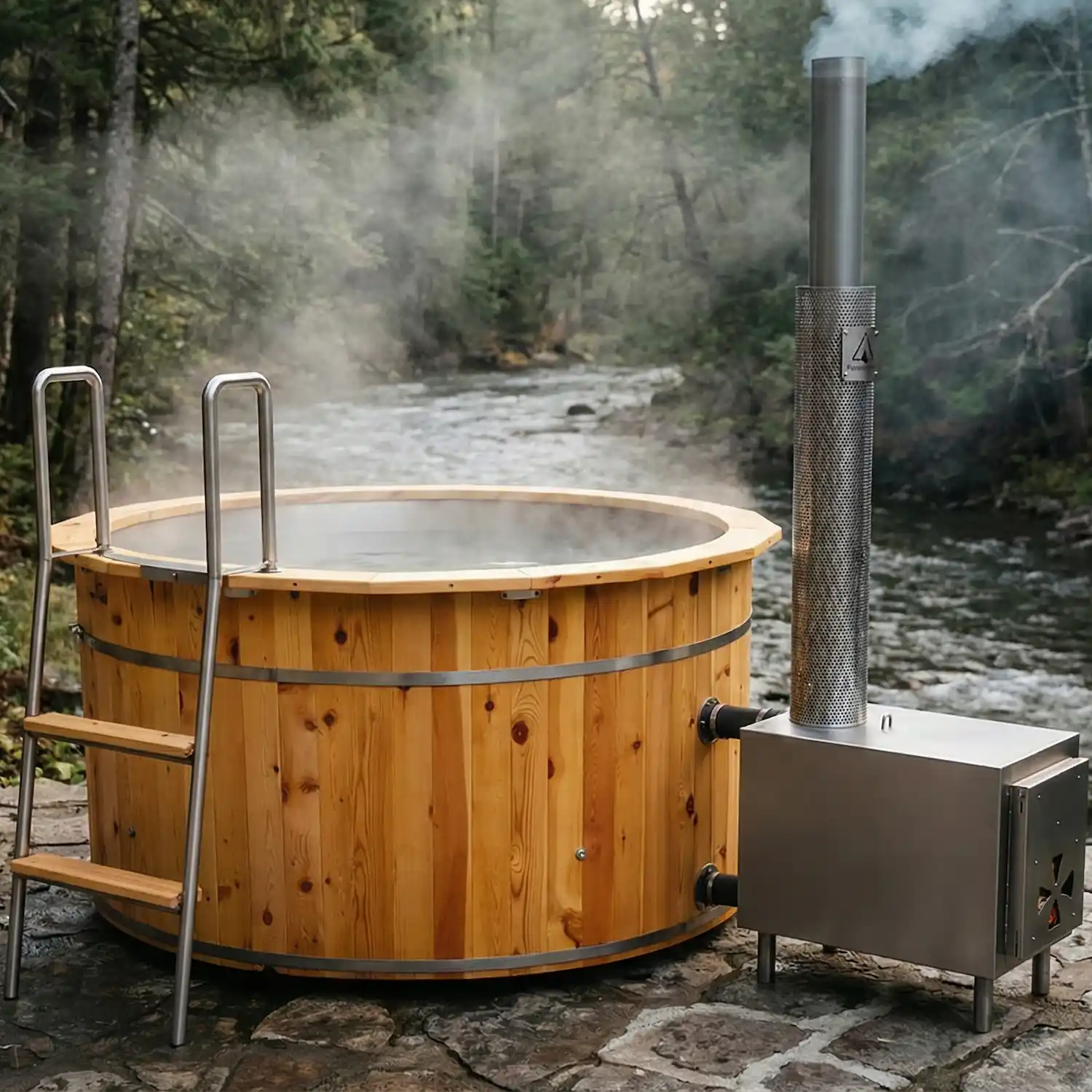
The external stove is connected to the tub by two hoses and has a double wall with the water sitting in between. Cold water is drawn in at the bottom, heats up between the stove walls, rises and flows back through the upper hose. That circulation runs purely on the temperature difference – which means no pump and no electricity.
For choosing a location, that is the decisive difference compared to an electric hot tub. You do not have to dig a trench, you do not have to get a heavy-duty supply installed, and you do not have to arrange everything around wherever a socket happens to be. The tub can stand where the view is best – at the far end of the garden, at the edge of the woods, up on an alpine pasture or on a plot with no connections at all.
When there is no garden: terrace, balcony and courtyard

A garden of your own is not a requirement. We have tubs standing on terraces, in inner courtyards and on generous balconies – the electricity-free construction is what makes that possible in the first place.
What you should clarify beforehand in those cases is the structural load. On a balcony or a roof terrace, the total weight of around one tonne absolutely belongs in the hands of a qualified professional, and in a rented property you also need the owner’s consent. Once that is settled, there is nothing standing in the way.
Smoke, neighbours and permits
A hot tub is not a building: it has no foundation, no fixed connections, and it can be moved again at any time. In the vast majority of municipalities it therefore does not require planning permission. But because building regulations vary from region to region, a quick call to your local authority is worth it if you are in any doubt – particularly if you are planning to build a fixed platform or an enclosure around it.
The topic that comes up more often in practice is smoke. A cleanly managed fire with dry wood only smokes noticeably while you are lighting it and draws away almost invisibly afterwards. Even so, it is sensible not to point the flue directly at the neighbours’ terrace, and to leave damp wood out of it consistently. And if you invite your neighbours over now and again, the subject usually takes care of itself.
Water in, water out
An ordinary garden hose is all you need for filling. Depending on your water pressure, around 750 litres are in within roughly half an hour. One point is essential here: only light the stove once it is completely filled with water – that is, once the water level in the tub sits above the upper hose connection. The stove is cooled solely by the water surrounding it, so if the fire is already burning before that, it can overheat and be damaged.
Before draining, give a little thought to where the water should go. Because the inner tub is made of seamless V4A stainless steel, you need neither chlorine nor bromine – the water is harmless and can go onto the lawn or into the beds. Even so: spread the volume out rather than tipping it into the grass all in one spot. A slight fall away from the tub is the simplest solution.
Leave it outside all year round
The tub stays exactly where you put it, all year long. There is nothing to dismantle and nothing to winterise. The only rule that genuinely matters: when frost is forecast, drain the water once you have finished bathing. Tub, stove and hoses then stay empty and nothing can freeze.
That, incidentally, is the biggest difference to an electric hot tub, which gets covered up in autumn and only started again in spring because heating around the clock at sub-zero temperatures is expensive. With a wood-fired tub it works the other way round: the colder it is outside, the better the experience gets. A cover keeps leaves and snow out of the empty basin in between.
The facts about the Feuerwasser Stainless Steel Hot Tub
- Material: 4 mm V4A stainless steel inside, solid pine outside
- Capacity: for 2 people
- Water volume: around 750 litres
- Dimensions: outer diameter 180 cm
- Footprint: approx. 3.10 × 2.60 m including the stove
- Stove: external V4A stove, entirely without electricity
- Heating time: around 2 to 2.5 hours
- Warranty: 5 years on the stainless steel body
- Origin: handcrafted in Austria, free delivery (mainland EU & Switzerland)
Conclusion: your garden has to do less than you think
A hot tub for the garden makes fewer demands than most people expect: around three by two and a half metres of space, a level and load-bearing base, a garden hose and a metre of clearance around the stove. Electricity, foundations and chemicals are not on the list.
Everything beyond that is a question of the view. And because a stainless steel hot tub with an external stove lasts for decades, you are more than entitled to take your time choosing the spot.
Crafted for the Elements.
Want to know what your hot tub would cost? Request your individual quote now.

About the author
Karlheinz Levounigg worked at Feuerwasser back in 2023 and knows the hot tub, bathing barrel and outdoor shower from the inside. Today, as co-founder of SWIFTGREEN OG, he looks after the Feuerwasser website and online marketing.
His articles focus on what matters in practice: the right location, heating up, care and the honest question of which product suits whom. Crafted for the Elements.