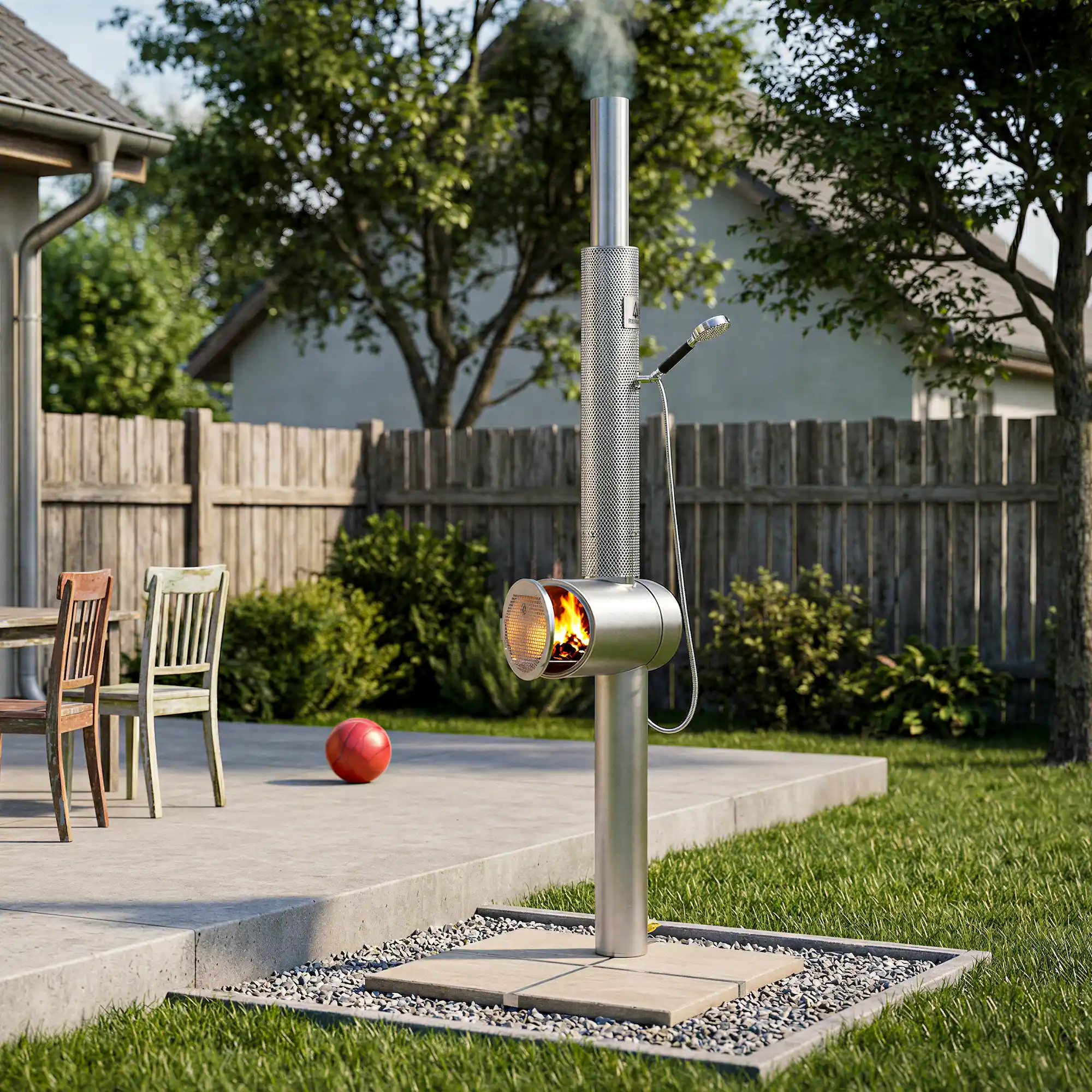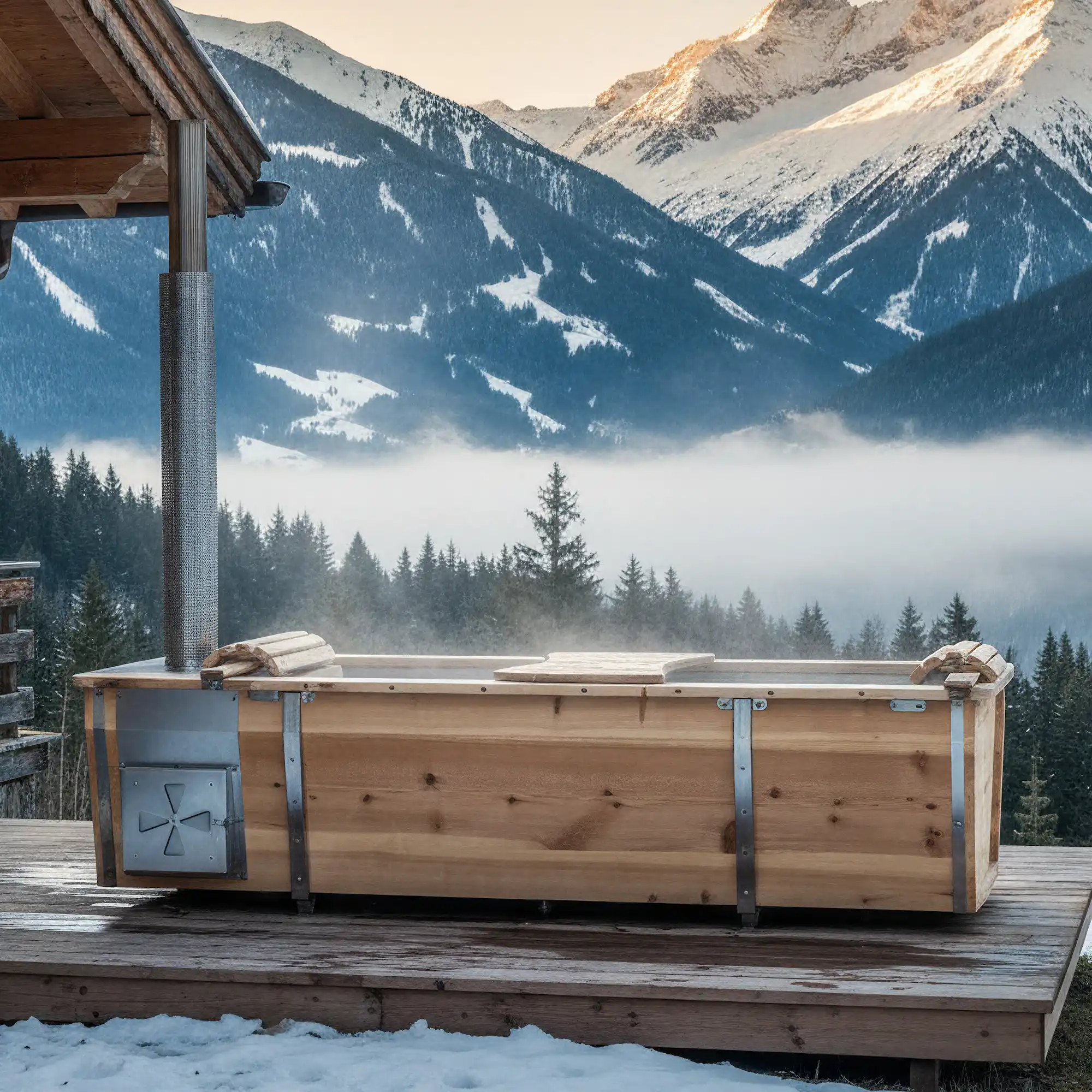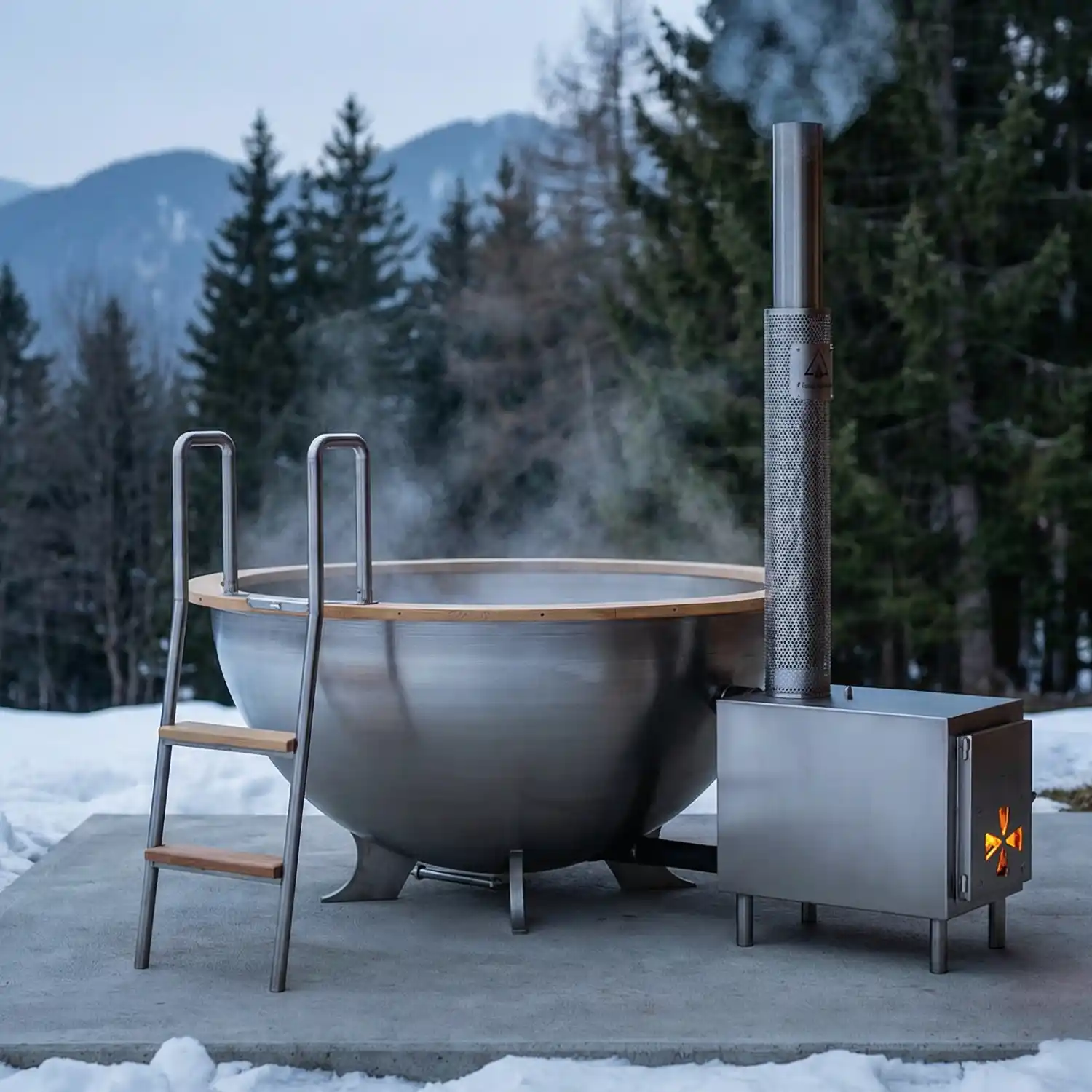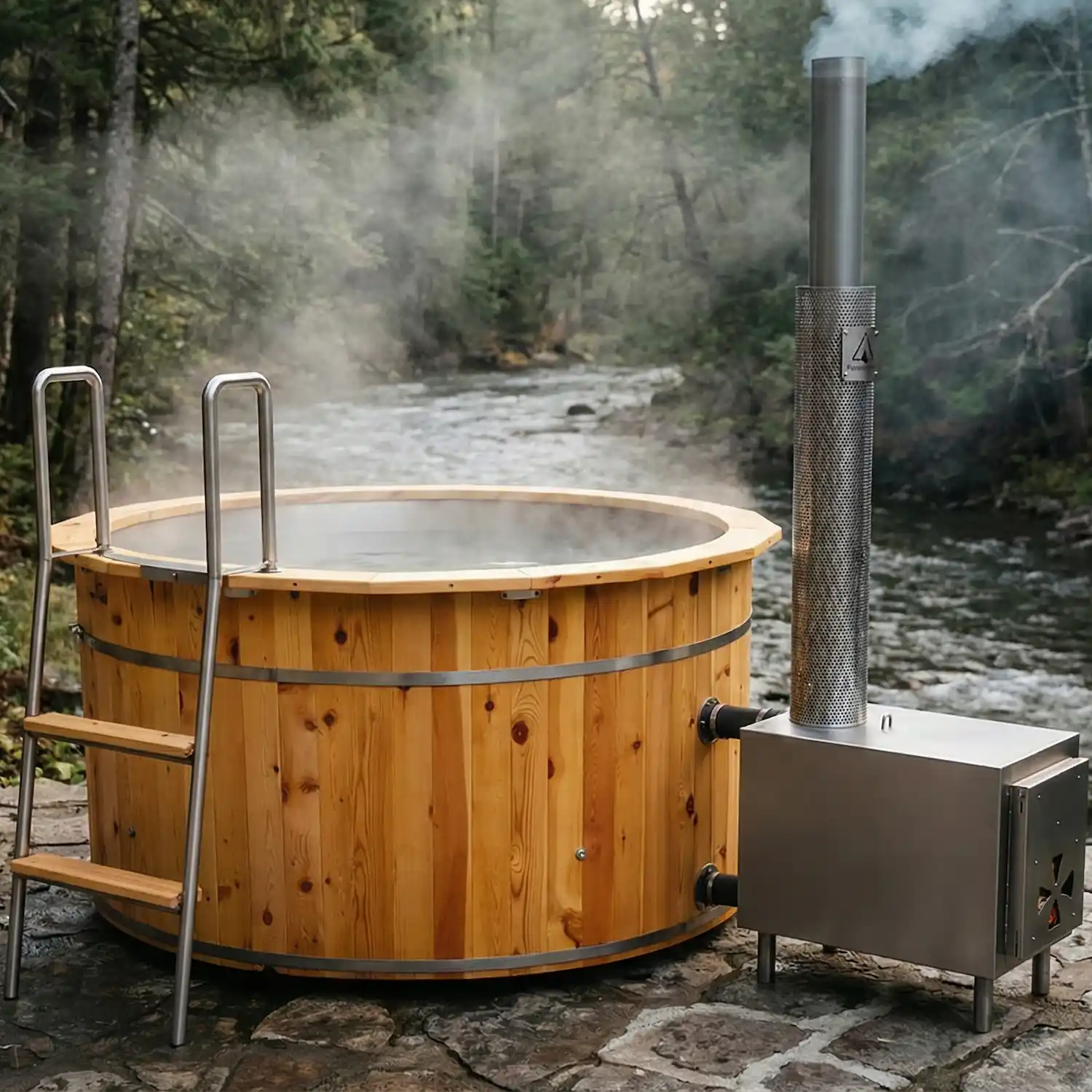
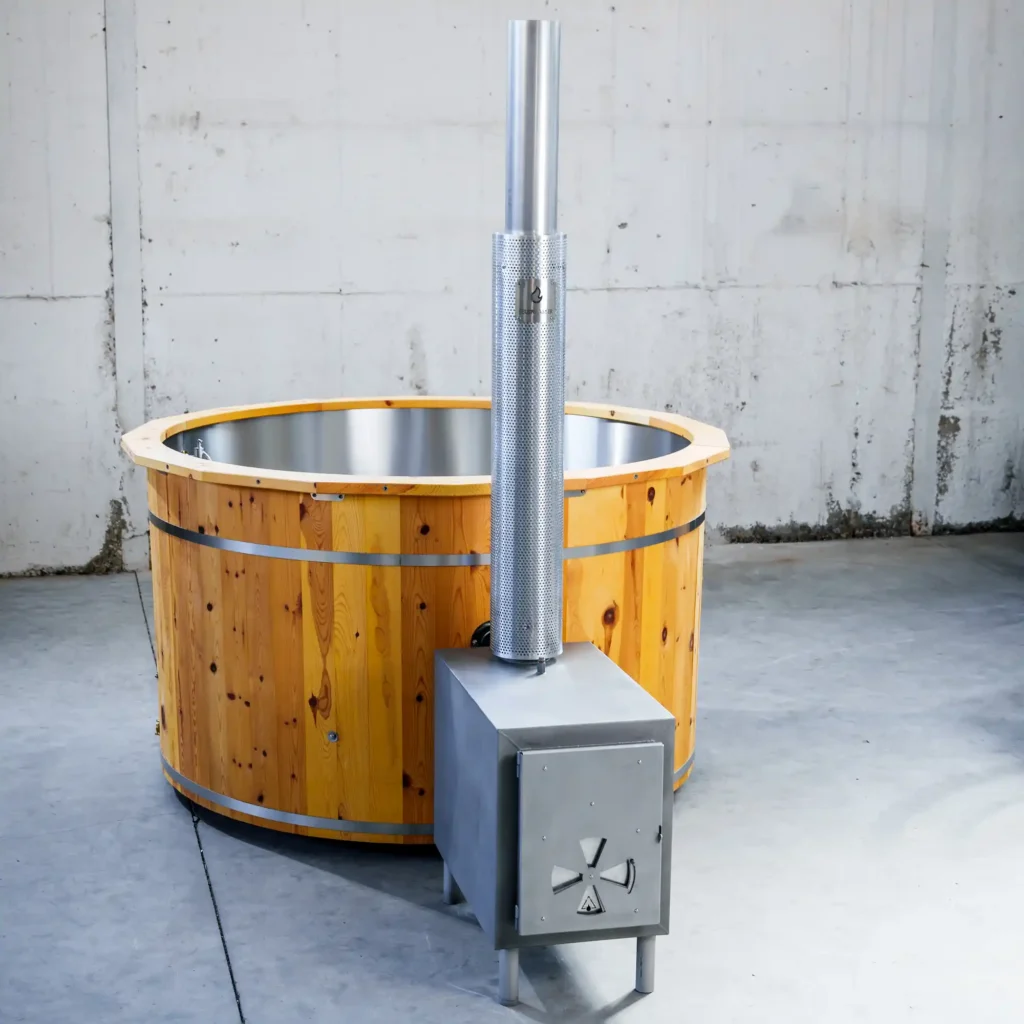
You are looking for a wood fired jacuzzi, meaning hot water in your own garden, heated by a real fire rather than by a monthly electricity bill? Here is the honest answer straight away: a jacuzzi with a wood stove does not exist in that form. “Jacuzzi” is a protected brand name for tubs with massage jets, and those jets need a pump, which in turn needs a permanent power supply.
What does exist is precisely the thing most people actually mean: a bathing barrel with a wood-fired stove. In this article we take a proper look at what you get, what you deliberately do not get, why the design of the stove matters more than most people expect, and what running one really costs over the years.
Why “wood fired jacuzzi” is a contradiction
Jacuzzi is not a product category, it is a brand, named after the Jacuzzi brothers, who built the first underwater massage pump back in the 1950s. Ever since then the word has been used as shorthand for more or less anything that bubbles.
And that is exactly where the problem starts: the bubbles come from jets, the jets need a pump, and the pump needs a constant supply of electricity. A wood stove, by contrast, does exactly one job, but it does that one job extremely well: it makes the water hot.
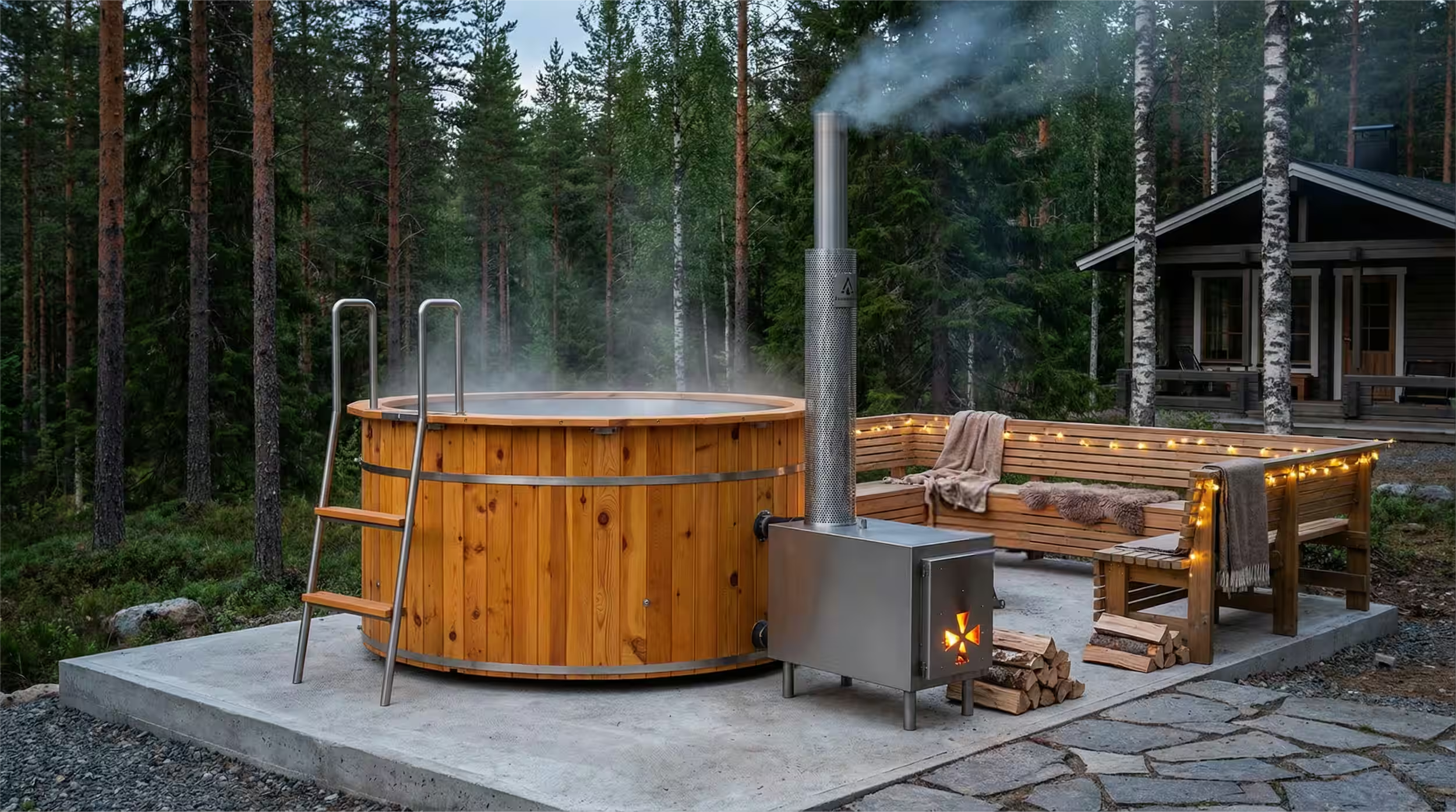
Most people searching for a wood fired jacuzzi are not really after the massage function at all. They are after the feeling behind it: sitting outside, hot water up to your shoulders, and no technology that needs babysitting. That is precisely what a stainless steel bathing barrel with an external stove is built for.
Can you retrofit massage jets?
Technically speaking, yes, you can. Air blower systems do exist and can in principle be connected to a bathing barrel. In practice, though, you bring back every single thing you originally wanted to get rid of:
- You need a permanent power supply at the location again, which takes away your free choice of spot.
- A blower is clearly audible, so you will no longer hear the fire crackling at all.
- Water is left standing in the air lines after every bath, and without regular disinfection that quickly turns into a hygiene problem.
- And finally, it is one more component that will eventually break.
Our honest opinion: we would leave them out. What makes the difference in the end is the heat, not the bubbles.
What the wood stove actually does
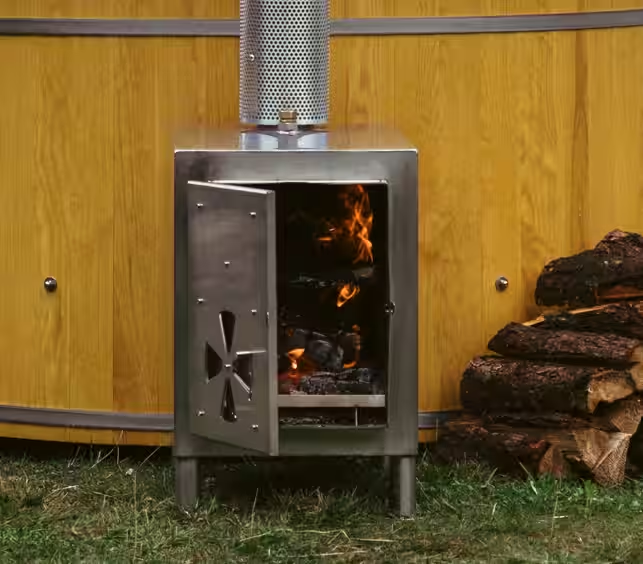
The external stove is made from 2 mm V4A stainless steel. It stands next to the barrel and is connected to it by two hoses. It has a double wall with water in between: cold water is drawn in at the bottom, heats up between the stove walls, rises and flows back into the barrel through the upper hose. The whole circulation runs purely on the temperature difference, which means no pump and no electricity.
With roughly 35 kW of heating power and four built-in heat exchangers, the stove brings 1,400 litres of water from 10 °C to 38 °C in 150 to 210 minutes. You regulate the temperature simply through the amount of wood you add and with cold water from the inside tap.
External or internal stove: a difference you feel every time
On some bathing barrels the stove does not sit beside the tub but inside it, as an internal stove surrounded by the bathing water on all sides. On paper that saves space, but in everyday use the design brings several drawbacks with it: lighting the fire is considerably more awkward, because you have to lean over the rim of the barrel and the stove barely draws while it is still cold. Clearing out the ashes becomes a wet and sooty job. And since the stove stands in the middle of the tub, it not only takes away seating space, it also means you are sitting right next to glowing hot metal the whole time you bathe.
We built internal stoves ourselves years ago and then took them out of our range again quite deliberately, simply because many of our customers never managed to get a decent fire going with them. With an external stove the fire burns where it belongs: outside the barrel, easy to reach at any moment, with a proper draught and with no hot surfaces anywhere in the bathing area.
There is one exception in our range: the Feuerwasser Outdoor Bathtub. It does have an internal stove, but built in a completely different way. The stove sits neatly tucked away behind the wooden backrest you lean against while bathing, and you operate it from the side, just as comfortably as an external stove. You can reach the fire at any moment without leaning over the rim, and there are no hot surfaces in the bathing area itself.
Running costs: wood versus electricity
This is where the difference becomes really tangible. For one heating session you need roughly as much wood as fits into a box measuring 40 × 30 × 100 cm. A single cubic metre of firewood therefore gives you around nine bathing sessions. Which species you burn barely matters: spruce burns hot and fast, but branches or an old delivery pallet do the job just as well.
An electric hot tub does the maths in a completely different way. It does not only heat when you actually bathe, it keeps the water warm, filters and pumps around the clock, all year long. On top of that come chemicals, filter cartridges and, sooner or later, a repair to the pump or the control unit.
With a bathing barrel you pay properly once for the product, and after that you pay in firewood.
Winter is when it makes the most sense
Most jet tubs get covered up in autumn and only started again in spring, because heating around the clock at sub-zero temperatures becomes genuinely expensive. With a bathing barrel it works exactly the other way round: the colder it is outside, the better the experience gets. Snow on the ground, 38 °C in the water and smoke rising from the flue: that combination is the reason most people buy one in the first place.
Really only one thing matters here: when frost is forecast, drain the water once you have finished bathing. Barrel, stove and hoses then stay empty and nothing can freeze.
Care without chemicals
The inside is made of non-porous V4A stainless steel: smooth, completely sealed and without a single joint. Bacteria and biofilm simply have nothing to cling to on a surface like that, which is exactly why you need no chlorine, no bromine and no test strips.
The routine after a bath is correspondingly short: drain the water through the floor outlet, wipe down the walls, and that is it. There is no filter to change and no pipework to flush.
Location: no power supply needed
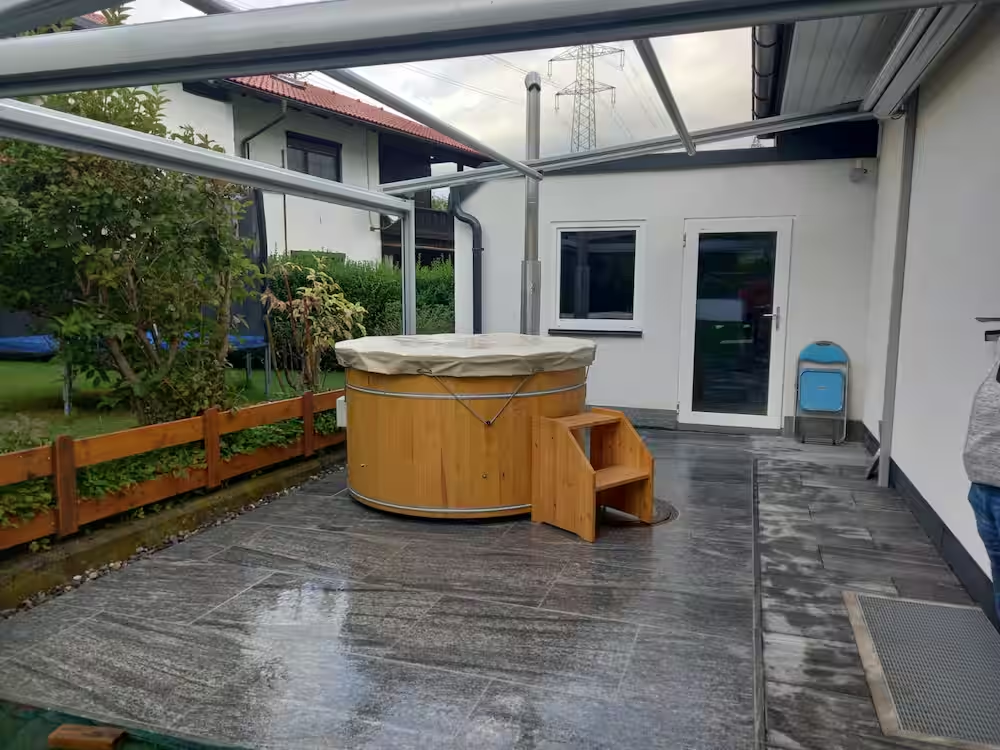
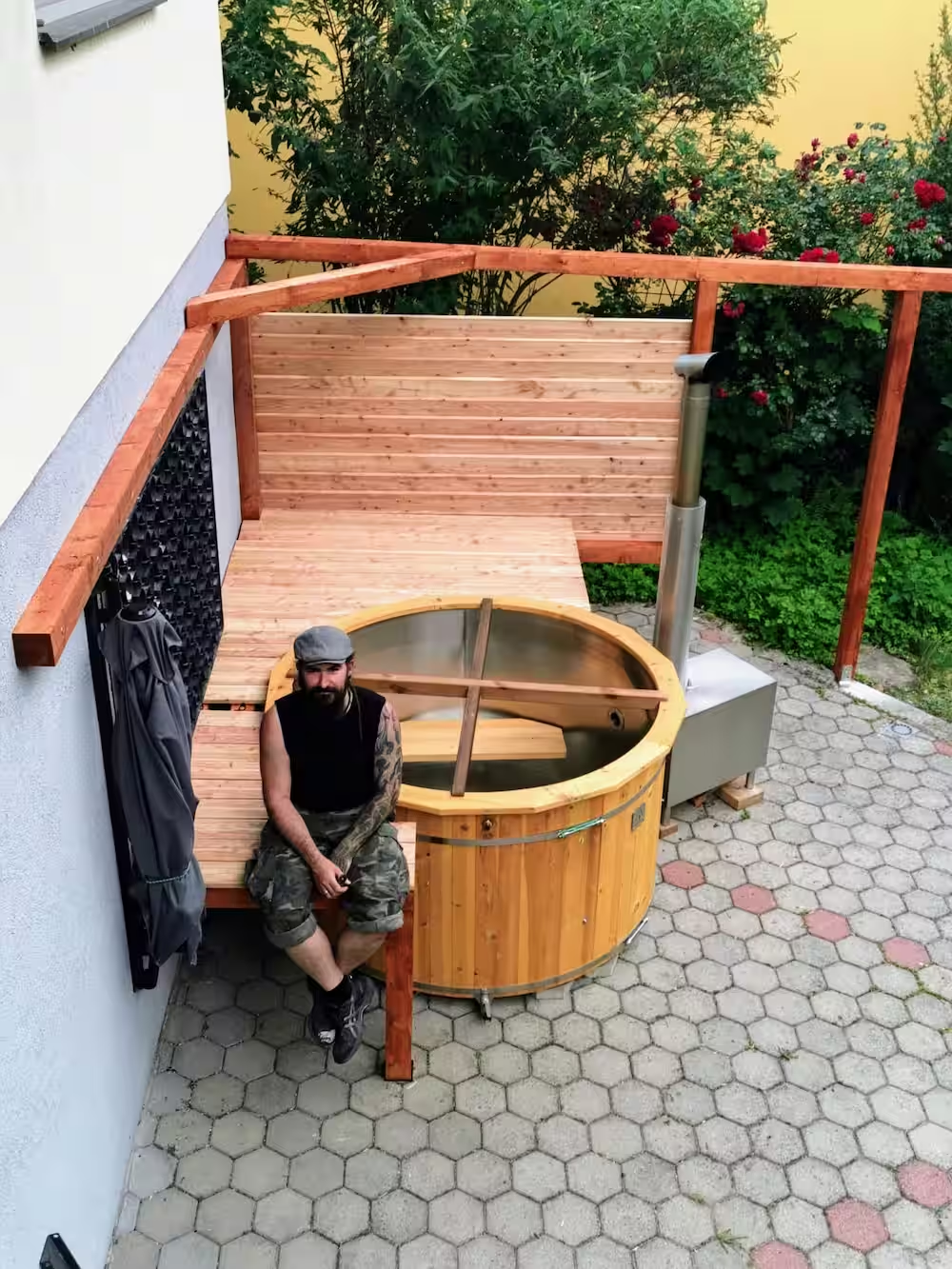
Because neither the heating nor the circulation needs electricity, you are completely free to choose your spot. What the surface has to manage is quickly listed:
- it has to be level and able to carry at least 2 tonnes, so stone or washed concrete slabs are ideal
- a base of roughly 3.10 × 2.60 m, so that barrel and stove fit side by side
- around one metre of clearance all around the stove, so nothing sits too close to the heat
- water for filling, an ordinary garden hose is entirely enough
Garden, alpine pasture, forest edge or a plot with no connection at all: every one of those works without a problem.
The facts about the Feuerwasser stainless steel bathing barrel
- Material: V4A stainless steel inside, solid pine outside
- Capacity: up to 6 people
- Volume: 1,800 litres (filled with approx. 1,400 litres)
- Dimensions: outer diameter 180 cm, height 105 cm
- Stove: external V4A stove, approx. 35 kW
- Heating time: from 10 °C to 38 °C in 150 to 210 minutes
- Warranty: 5 years on the stainless steel body
- Origin: handcrafted in Austria, free delivery (mainland EU & Switzerland)
Conclusion: not a jacuzzi, but probably exactly what you want
A wood fired jacuzzi would be a compromise between two worlds that ends up making both of them worse than they are on their own. What you get instead is far clearer: hot water with real fire, no electricity bill, no chemicals and no plastic. A stainless steel bathing barrel with an external stove lasts for decades, instead of getting a little more broken with every season that passes.
Crafted for the Elements.
Want to know what your bathing barrel would cost? Request your individual quote now.

About the author
Karlheinz Levounigg worked at Feuerwasser back in 2023 and knows the hot tub, bathing barrel and outdoor shower from the inside. Today, as co-founder of SWIFTGREEN OG, he looks after the Feuerwasser website and online marketing.
His articles focus on what matters in practice: the right location, heating up, care and the honest question of which product suits whom. Crafted for the Elements.