You type “wood-fired hot tub” into the search bar, dreaming of hot water under the open sky, and you would rather have it without an electricity bill, without a service technician and without the smell of chemicals? Then you are in exactly the right place. There is one small but important thing we should tell you straight away: a wood-fired hot tub is not the plug-in, jet-powered whirlpool most people picture. It is heated by real fire – and honestly, that is the far better news.
In this article we take a calm look at how a wood-burning stove actually brings the water up to bathing temperature without a single watt of electricity, why it makes a considerable difference whether the stove sits inside or outside the tub – and why stainless steel outlasts its plastic competition by a wide margin.
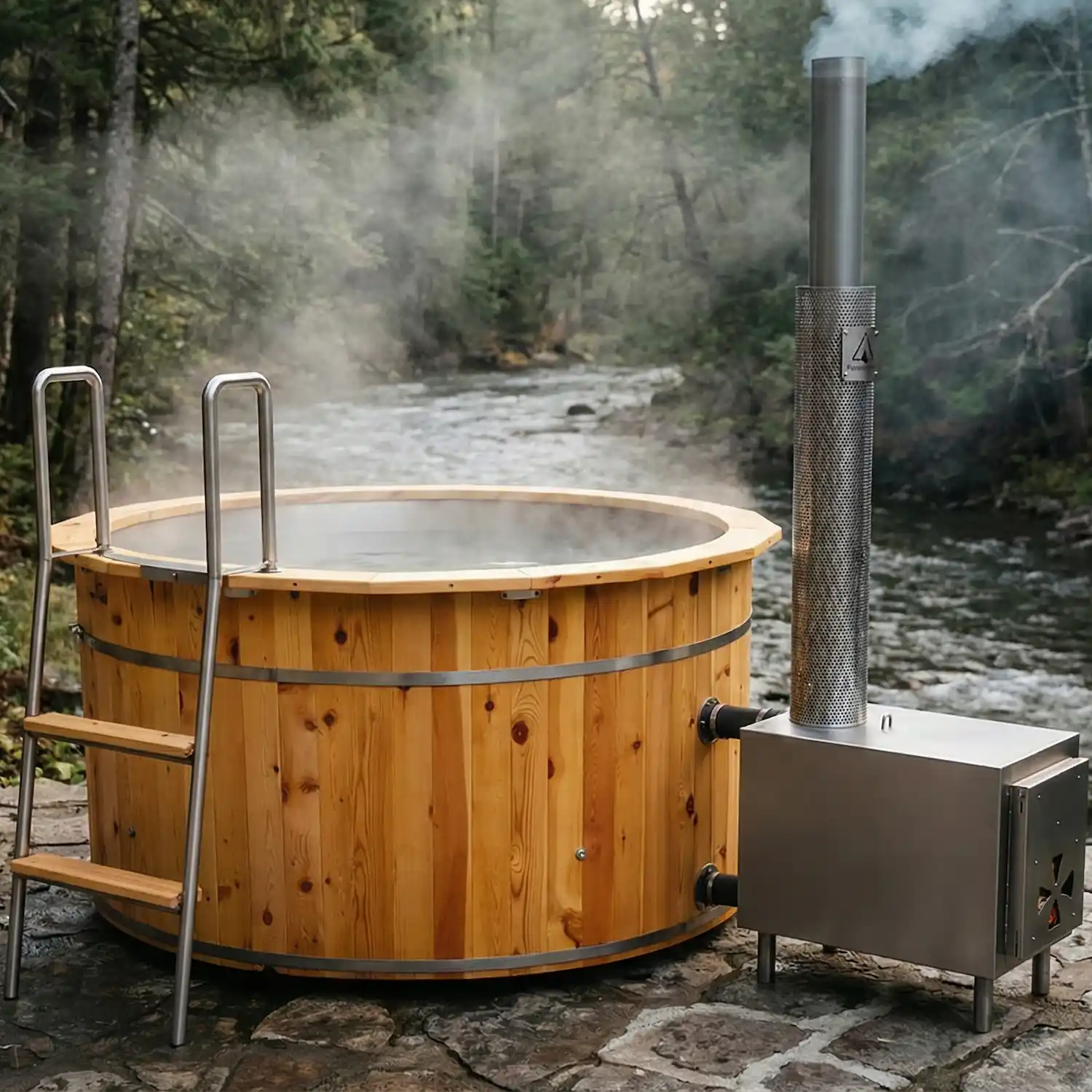
Whirlpool, hot tub or bathing barrel – what are you really looking for?
These three terms get thrown around online more or less interchangeably, so let us sort them out properly:
- Whirlpool / jacuzzi: What is actually meant here is a tub with massage jets, run on electricity, a pump and, in the vast majority of cases, chemicals in the water as well.
- Hot tub: The umbrella term for the hot barrel in your garden – regardless of whether it is brought up to temperature with wood or with electricity.
- Wood-fired hot tub (bathing barrel): The Scandinavian classic. A barrel heated purely by a wood-burning stove, which needs no electricity, no pump and no chemicals at all.
Anyone searching for a “wood-fired hot tub” almost always means that last option: hot water, real fire and no dependence on technology that will eventually give up on you. So let us talk about the stainless steel bathing barrel with an external stove.
How does a wood-fired hot tub work?
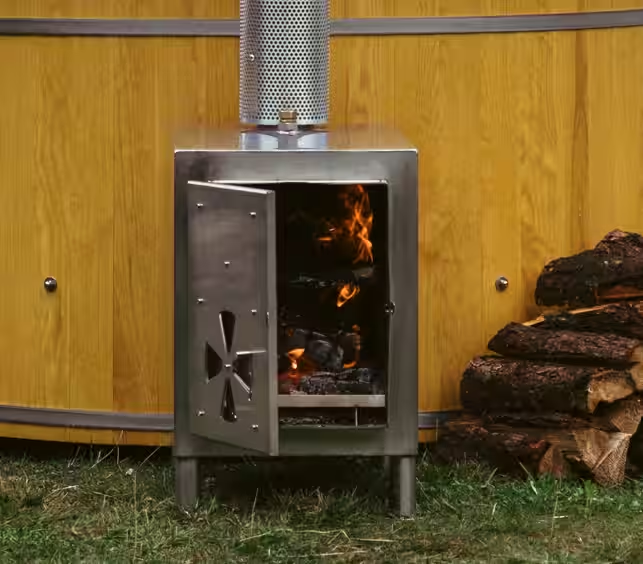
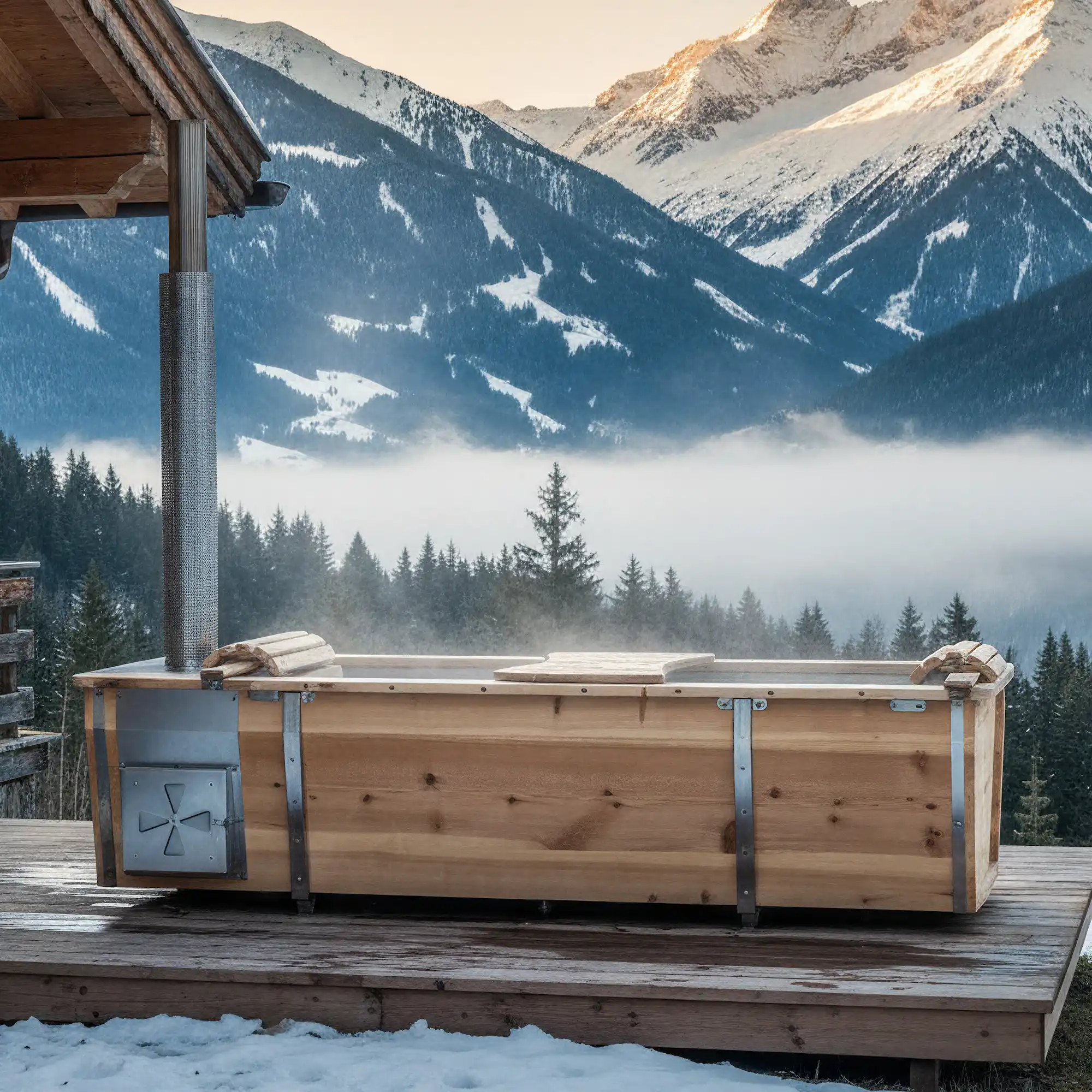
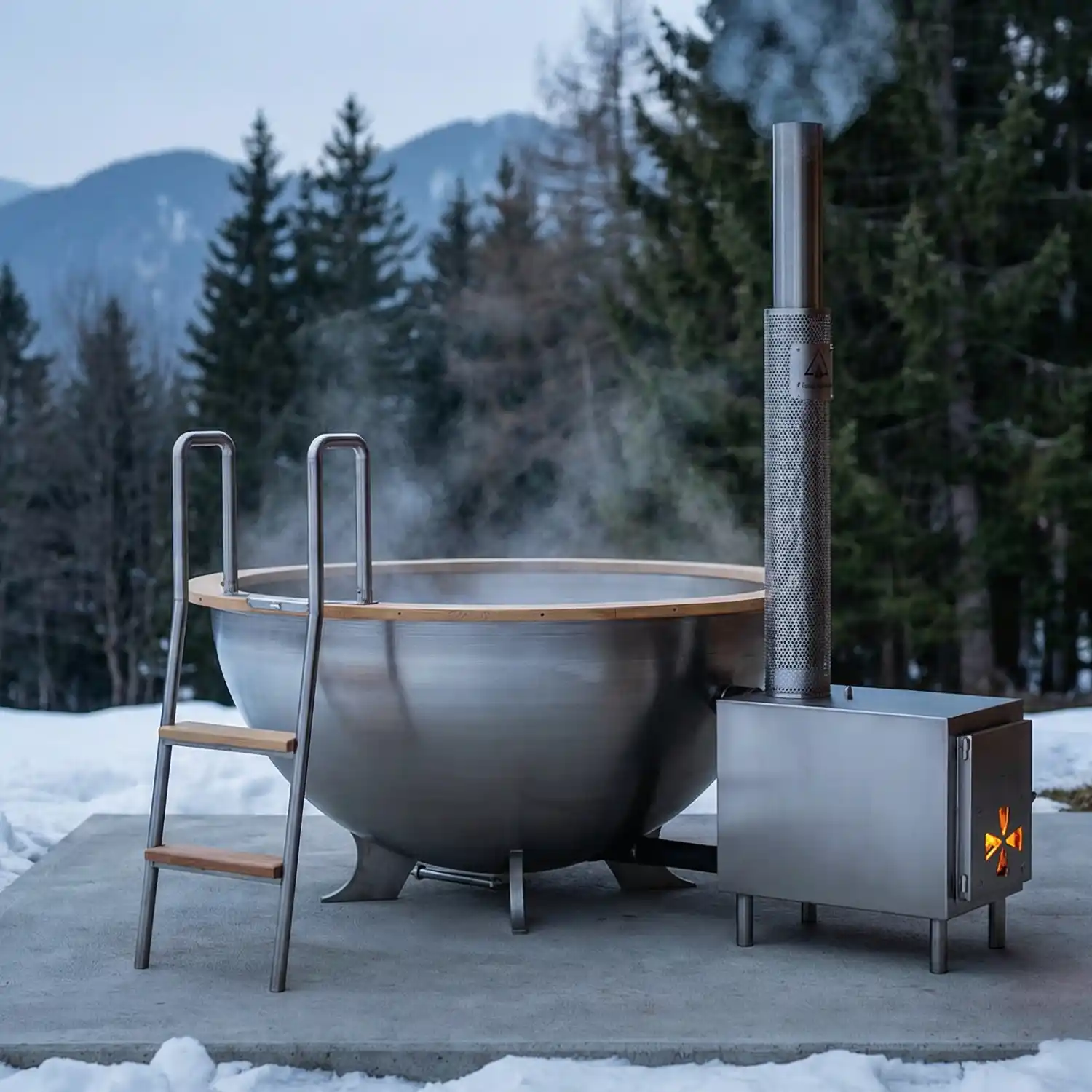
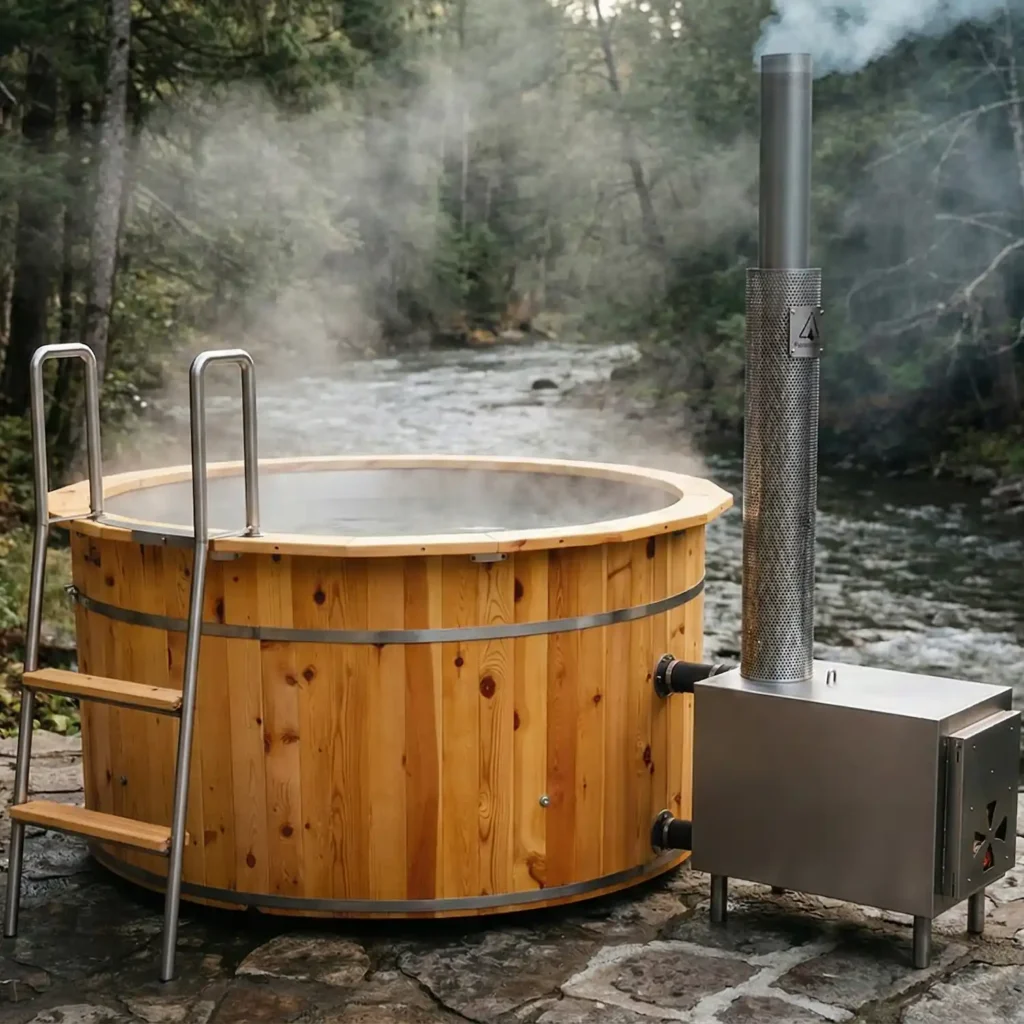
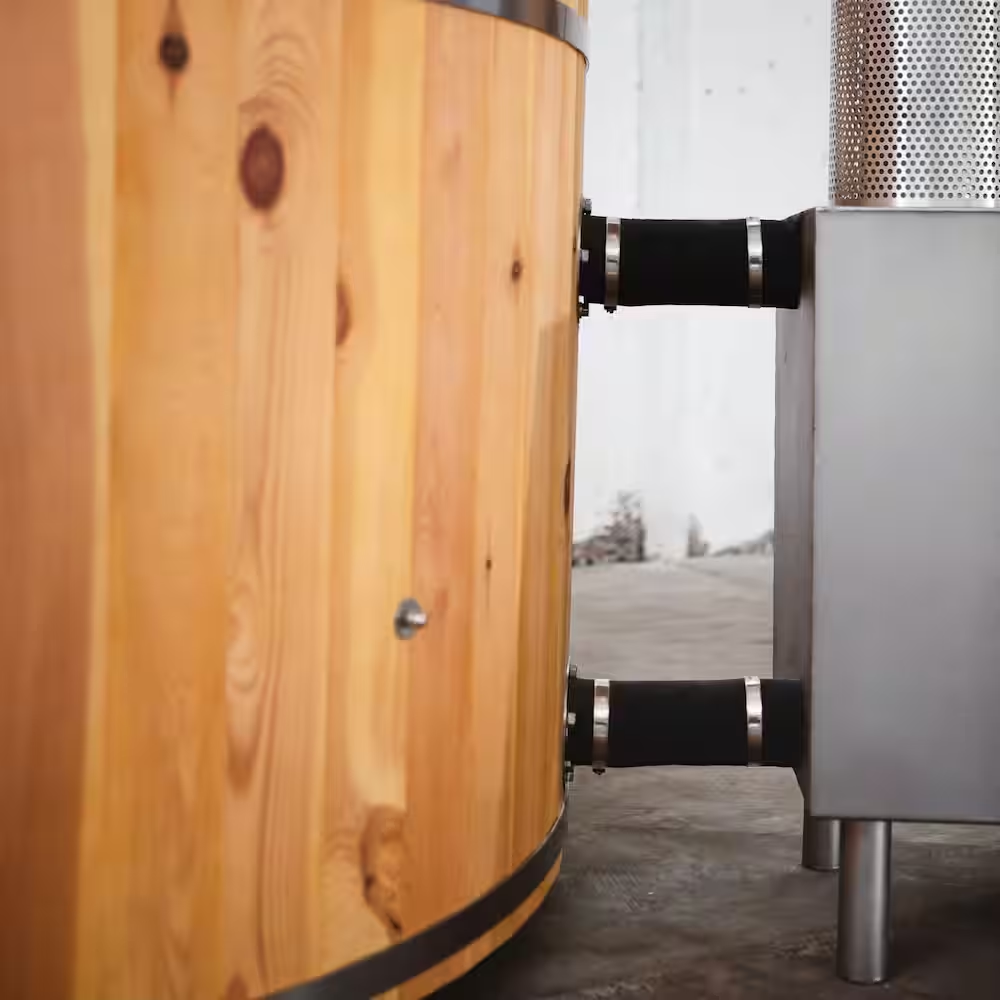
The heart of the whole thing is the external wood-burning stove made of V4A stainless steel. It stands next to the barrel and is connected to it by two hoses. The stove has a double wall with water in between, and as soon as the fire is burning properly, a circulation gets going entirely on its own:
- Cold water is drawn into the stove through the lower hose.
- The fire heats it between the two stove walls.
- The warm water rises and flows back into the barrel through the upper hose all by itself.
This thermosiphon principle is a purely physical process that works completely without electricity and without a pump. That is precisely why a bathing barrel like this can be set up almost anywhere: in the garden behind the house, down by the river, or on a mountain pasture where there is not a power socket for miles.
External stove or internal stove – where should the fire burn?
Not every hot tub is heated the same way. Some manufacturers rely on an internal stove that sits inside the tub itself and is surrounded by the bathing water on all sides. At first glance that looks compact and practical, but in everyday use this design brings several drawbacks with it: lighting the fire is far more fiddly, because you have to lean over the rim of the tub and the stove barely draws while it is still cold. Clearing out the ashes turns into a wet, sooty job. And because the stove stands in the middle of the tub, it not only takes away valuable seating space, it also means you are bathing right next to a glowing hot metal wall the entire time.
We built internal stoves ourselves years ago and then deliberately took them out of our range again – simply because a lot of our customers never managed to get a decent fire going with them. With an external stove, the fire burns exactly where it belongs: outside the tub, easy to reach at any time, with a proper draught – and without anyone in the water accidentally touching hot steel.
With around 35 kW of heating power and four integrated heat exchangers, the external stove brings the water from 10 °C to a bath-ready 38 °C in roughly 150 to 210 minutes. That may sound like a long wait, but in truth it is the most enjoyable part of the ritual: you add another log, listen to the fire crackle, catch the smell of woodsmoke – and start winding down long before you get in.
Electric whirlpool vs. wood-fired hot tub
So why not simply go for the convenient push-button whirlpool after all? Because convenient, in this particular case, also means expensive, noisy and dependent – and that difference becomes very obvious the first time you look at your electricity bill.
Electric whirlpool with jets:
- needs a permanent, often high-voltage power connection
- generates ongoing costs through the pump, heater and filter
- requires chemicals in the water for the hygiene to work at all
- comes with vulnerable technology – pumps and electronics break down eventually
- is tied to the location of the power socket
Wood-fired hot tub:
- needs no power connection whatsoever, only wood and water
- creates no ongoing electricity costs at all
- works without chemicals, because you simply drain it after your bath
- is virtually maintenance-free, as there is no sensitive electronics to fail
- can be set up anywhere the ground is level and load-bearing
Why stainless steel instead of a plastic whirlpool?
Most cheap “wood-fired hot tubs” have an interior made of plastic or fibreglass. Tubs like that fade visibly after a couple of seasons, smell distinctly of plastic once they warm up and release substances into the bathing water under heat. Feuerwasser therefore deliberately uses pore-free V4A stainless steel, clad on the outside with solid pine wood.
- 100% watertight – nothing swells up and nothing warps, as it can with a purely wooden barrel
- hygienic – the smooth, pore-free surface gives bacteria nothing to cling to, entirely without chemicals
- robust and durable – a tub like this lasts decades rather than a couple of summers
- sustainable – stainless steel is 100% recyclable
- elegant look – modern, gleaming metal combined with real, warm wood
In short: you pay properly once, instead of buying a new plastic tub every few years.
Who is a wood-fired hot tub for?
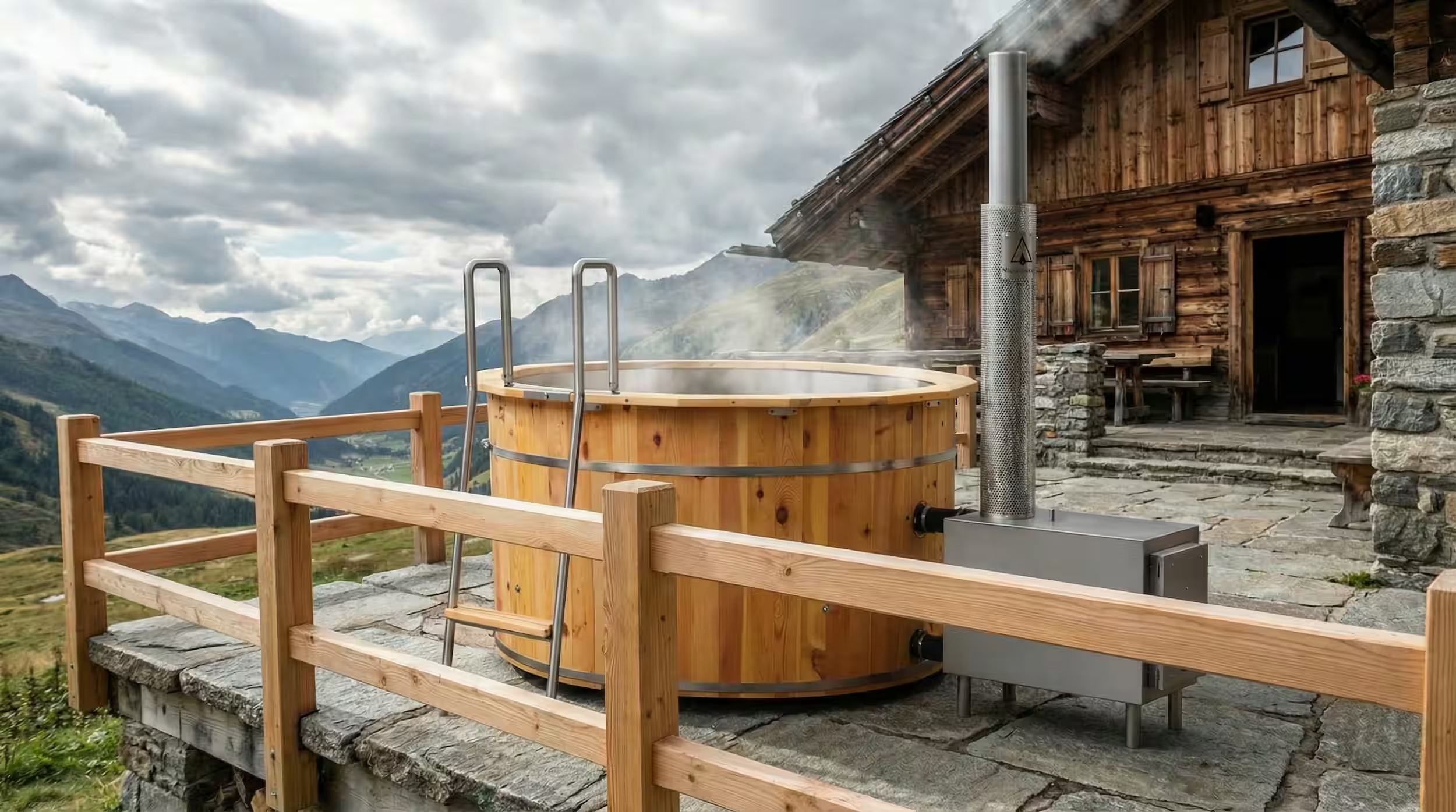
A wood-fired hot tub is exactly the right choice for you if you:
- love bathing in hot water under the open sky, in high summer just as much as in the middle of winter
- have no appetite for rising electricity bills, sensitive pumps and chemicals in the water
- value an honest, long-lasting natural product that will stay with you for many years
- want a real ritual: light the fire, wait, dive in and finally switch your head off
The facts on the Feuerwasser stainless steel bathing barrel
- Material: V4A stainless steel inside, solid pine wood outside
- Capacity: up to 6 people
- Volume: 1,800 litres (fill quantity approx. 1,400 litres)
- Dimensions: outer diameter 180 cm, height 105 cm
- Stove: external V4A stove, approx. 35 kW
- Heating time: from 10 °C to 38 °C in 150–210 minutes
- Warranty: 5 years on the stainless steel body
- Origin: handcrafted in Austria, free delivery (mainland EU & Switzerland)
Conclusion: a wood-fired hot tub means real fire, not a plug
If you are looking for a wood-fired hot tub, what you really want is the freedom of a bathing barrel: hot water with real fire, no electricity, no chemicals and no plastic. A stainless steel bathing barrel with an external stove brings all of that together – and it will stay with you not for a few seasons, but for half a lifetime.
Crafted for the Elements.
Want to know what your bathing barrel would cost? Request your individual quote now.

About the author
Karlheinz Levounigg worked at Feuerwasser back in 2023 and knows the hot tub, bathing barrel and outdoor shower from the inside. Today, as co-founder of SWIFTGREEN OG, he looks after the Feuerwasser website and online marketing.
His articles focus on what matters in practice: the right location, heating up, care and the honest question of which product suits whom. Crafted for the Elements.